Civic Tech, AI Workflows, and Save Jodrell Bank
Why I built Save Jodrell Bank
I grew up not too far from Jodrell Bank. The Lovell Telescope was a familiar part of the Cheshire landscape, although it never felt ordinary to me. As I became more interested in science, I started to understand how interesting it was to have work with global significance happening so close to home.
Then, in July 2026, I saw the news about e-MERLIN's future funding. I kept seeing a complicated decision flattened into one alarming line: 'Jodrell Bank is closing'. It was memorable, but it also wasn't what had been announced.
The full explanation took longer, which was part of the problem. I wanted one place that set it out clearly and didn't disappear into institutional jargon. I was also on holiday, which was unfortunate timing. I worked on the project whenever I had some spare time, and less than 48 hours after I started, Save Jodrell Bank was live.
Those were elapsed hours. I did sleep. The work happened in short bursts spread across two days, and Generative AI made that pace possible. It also gave me plenty of content to check and review.
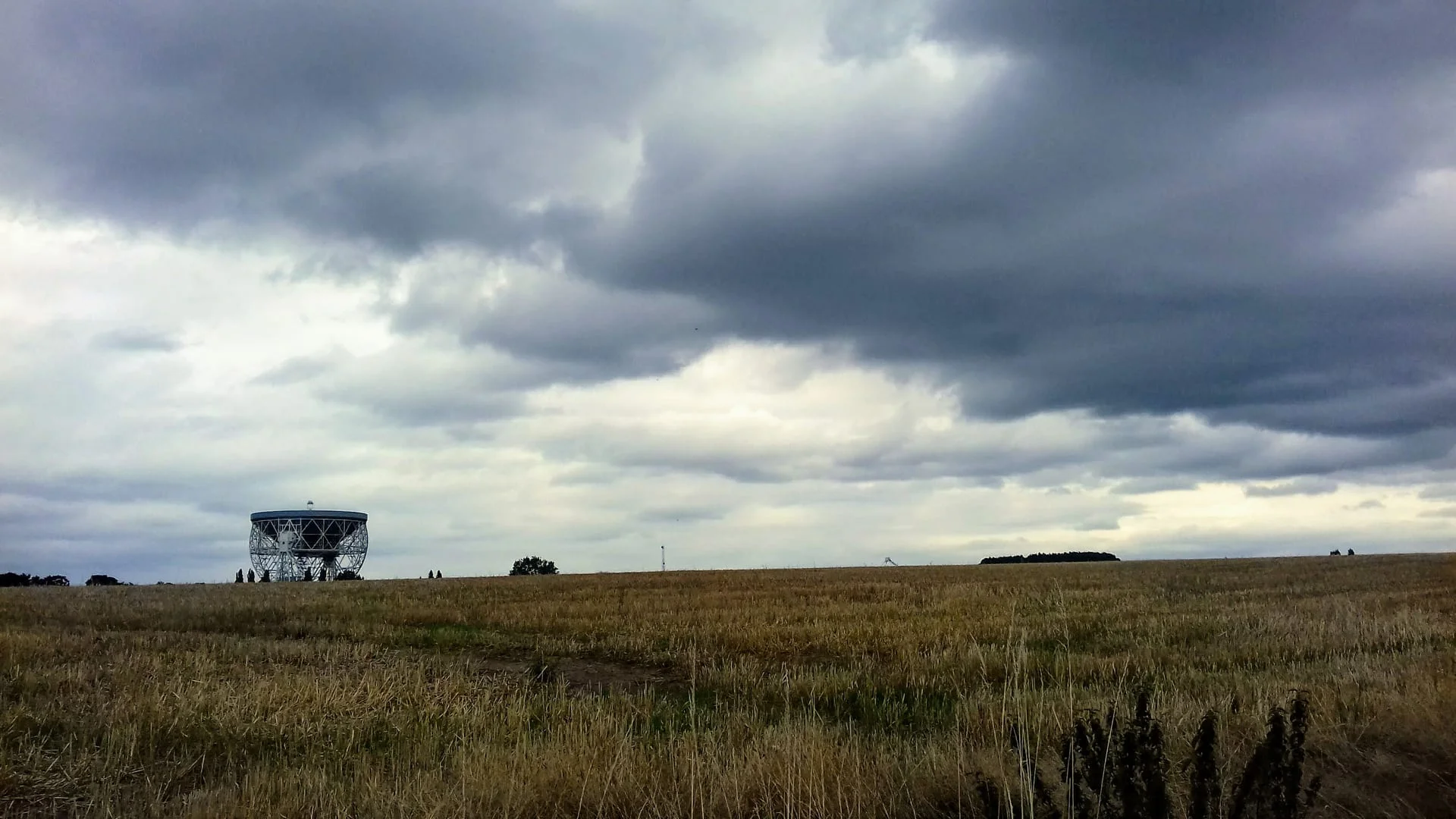
The Lovell Telescope at Jodrell Bank Observatory - Benjamin Shaw, CC BY-SA 4.0. Resized for web display.
So, what had actually happened?
On 9 July 2026, UK Research and Innovation (UKRI) published its Science and Technology Facilities Council prioritisation outcomes for 2026 to 2030. The outcome for 'e-MERLIN + JIVE' says that e-MERLIN was 'not prioritised for further funding'. UKRI also says current Particle Physics, Astronomy and Nuclear Physics projects continue in full until their existing agreements end.
The University of Manchester responded on 27 July. It said current e-MERLIN funding ends in March 2028. Jodrell Bank remains open, and the University is working with partners to secure the future of the Lovell Telescope and e-MERLIN.
For anyone unfamiliar with it, e-MERLIN is the UK's national radio astronomy facility. Seven selectable telescope stations are linked to Jodrell Bank by optical fibre, spanning up to 217 kilometres of Great Britain. Depending on the observation, either the Lovell or Mark II Telescope can provide the Jodrell Bank element.
The short version falls apart here. Jodrell Bank Observatory and the separately managed Centre for Engagement, which leads visitor and heritage activity, have different roles. The independent Square Kilometre Array Observatory also has its global headquarters on the site. The July decision applied to e-MERLIN's funding; nobody had announced the closure of the whole site.
There was still a serious problem. Without replacement support, e-MERLIN's scientific future and the Lovell Telescope's usual role beyond March 2028 were uncertain.
I kept coming back to that distinction while writing. If I was going to ask people to care, I couldn't begin by overstating the case.
Why it mattered to me
The local reason is the obvious one. I was born and raised nearby, and Jodrell Bank was part of the landscape long before I knew the dates or understood much of the science.
Only later did I understand the history behind it. Scientific work began there in 1945. The Mark I Telescope became operational in 1957, and the site joined the UNESCO World Heritage List in 2019. Today it remains a working scientific site alongside its heritage role.
My day job gave me another reason to pay attention. I work in research and technology for digitalisation at Airbus, where part of my role involves developing projects and navigating UK research and innovation funding. Aerospace R&T and radio astronomy operate in different worlds, but both rely on specialist teams, equipment and accumulated knowledge. Once teams disperse and continuity is lost, that capability can be difficult to rebuild.
A funding line on a spreadsheet can look like just another row. Its effects can last well beyond the accounting period.
This is a personal, independent project. My work provides context and does not imply Airbus involvement or endorsement. Save Jodrell Bank is not affiliated with UKRI, Jodrell Bank Observatory or the University of Manchester.
The idea (and two domains)
I settled on one rule: explain first and ask for action second.
The familiar campaign template - urgent slogan, petition button, very little context - felt wrong for this subject. Readers needed to understand what Jodrell Bank and e-MERLIN are, what UKRI had decided, what it hadn't, and which parts of the future remained uncertain. Asking them to help could come afterwards.
My references were science publications and museum websites: calm, spacious and properly sourced. I recorded the sources for important dates, figures and historical claims as I went. Leaving all of that until the end would have been a mess.
Before I had a homepage, I had two domains. Very developer of me.
I registered savejodrellbank.com and savejodrellbank.co.uk through Cloudflare and paid US$15.76 in total. Buying both wasn't necessary. I chose the .co.uk address as the main home and pointed the .com domain at it.
Those domains were all I spent on infrastructure. The hosting budget was £0.
Research came first
I had two domains at this point and still no homepage.
The deep-research tools in ChatGPT and Gemini helped me get my bearings. I used them to explore the observatory's history, science, funding, UNESCO status and the developing 2026 story. They found plenty. Then I had to go back through it. I treated the reports as reading lists and reopened the primary page behind each important public claim, recording its link, scope and access date myself.
A fluent AI summary can quietly merge two claims, lose a qualification or turn an estimate into an apparent fact. Sending the answer through a second model doesn't guarantee a fix. Sometimes it just produces the same error with better prose.
The reports themselves were huge. Codex helped me split them into smaller Markdown files under /knowledge, which became my working record for sources, caveats, contradictions and notes still waiting for a check. Reviewed long-form articles went into /content. I kept the rough research separate.
Then came the numbers.
Some of them looked great: funding, jobs, users. I couldn't verify and trace them back to the primary sources available to me, so they were removed.
Building it in small pieces
Before I asked Codex to build anything, I wrote down the decisions it shouldn't have to guess. AGENTS.md held the engineering and editorial rules. I put the audience, tone and product direction in PROJECT_CONTEXT.md, then used two phase plans to split the work into milestones small enough for me to review. Each one had a clear stopping point, and the context stayed in the repository instead of one enormous conversation.
It sounds more formal than it felt. Mostly, those files stopped each task from sprawling.
Each milestone got a fresh Codex conversation. The routine barely changed: read the relevant notes, inspect the existing code, do one defined job, run lint and a production build, review the changes, run some tests, commit them with Git, then push to GitHub. It got repetitive, which was fine. I always knew where that task ended.
Phase 1 covered the foundation: visual system, typography, accessible navigation, responsive layouts, homepage, metadata and Cloudflare deployment. Once that was stable, I moved on to the editorial work. Phase 2 added 17 planned pages about the observatory, its history and science, the funding situation, why it matters and ways to help. The models sped up the research, coding and review; I chose the objectives, checked the sources and reviewed the interface. Weak output went back for another pass.
I expected to use MDX because the knowledge base was already Markdown. Once the article layouts existed, typed TSX modules fitted the callouts, images, headings and metadata more cleanly without adding another compiler layer, so I dropped MDX from the plan.
Static by design
The site uses Next.js, React, TypeScript and Tailwind CSS. Underneath that stack, it is a static export.
Every editorial page is generated at build time and written to out/. Cloudflare Workers Static Assets serves those files, and each push to the production branch starts a new build. There is no database or CMS. There isn't even a long-running Node.js server waiting for a request.
This part is boring. Static files are easy to cache, the site is designed to stay light on client-side JavaScript, and the hosting target remains £0 per month. There are fewer moving pieces to cause problems later.
What I learned
A green build proves one thing: the code builds. It says nothing about whether a date, number or sentence is true. Lint caught broken imports and production builds caught invalid routes; the factual checks remained a separate job throughout.
The slippery part was watching uncertainty disappear between drafts. One model writes 'reports suggest'. Another model summarises it. A few steps later, the same claim comes back sounding established. Keeping the research notes separate made that easier to spot, and anything I couldn't verify was qualified or removed.
I had better results when I kept the jobs small. One milestone per conversation gave me shorter reviews, less context drift and a clear point at which to stop.
I went back over the central claim more than any other part of the copy. Saying that Jodrell Bank remained open while explaining the real uncertainty around e-MERLIN made a stronger case because readers didn't have to accept an exaggeration first.
What it became
My first sketch was basically a campaign landing page. What went live was broader: a connected guide to the observatory, the funding decision, what remains uncertain and what people can do next.
I'm glad I made it. Jodrell Bank helped spark my interest in science when I was young, and perhaps influenced my decision to work in the Aerospace industry. Years later, this project gave me a useful way to give something back.
Thank you for reading. You can visit the website here.